Sunday, 27 April 2014

Art Direction

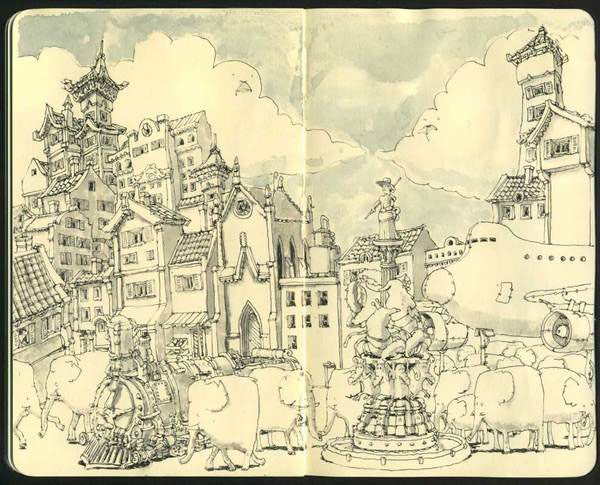
Not long ago I have given a presentation in my Critical Studies module about an artist that really inspires me with his work - Mattias Adolfsson. In this post I will talk about him and explain what it is about him that inspires me.
Here I have put all the images that I have used in my presentation and beneath you can find a small summary of each point.


Composition:
His work is very unique as he puts a lot of details into his drawings and he avoids leaving any negative space while at the same time, manages to make his drawings seem unique.


Shape/Form:
He is a 2D artist which has a way of making his drawings look 3D when he finds it appropriate. The main themes in his work are modes of transport/architecture as also all kinds of animals.


Colour:
When it comes to using color, he is really careful and his colour usage can vary from fully covered drawing to just simple line work. Sometimes he uses one colour just to visually separate objects.


Lighting:
To be honest it was a quite difficult to find a good example of him using lighting as he does not use colour as much, but when he does he keeps it subtle and with previously mentioned use of colours he uses, it only adds to the 2D/3D effect.


Atmosphere:
The atmosphere in his drawings tends to be, in my opinion very innocent, child-like and very friendly while having this old school, 1960's feel to it. The bizarre nature and the oddity of his pictures make them seem interesting as well as welcoming.


Why is it awesome?
The reason why I like his work is because, you can really see that there are no limits to his imagination. The connection between vivid imagination and childhood makes you feel like there is no hostility in his drawings.

Story:
Also I like to think that each of his drawings tells a story for example; I can't help but to think that the crew on the ship has its own history and the pictures are just capturing one of the many moments.


Machinarium:
In response as to how his style could be used in a game, I want you to consider that games nowadays are all about hyper-realistic graphic and visuals but there is very little creativity and I think Machinarium its a good example to show that this type of style can be very interesting in a game concept.

In my spare time I work on expanding my visual library. I do this by collecting all sorts of different images that I find interesting for example bizarre fashion or paintings in all sorts of media, I also like to take my own photographs of different object or places that I find beautiful. Also apart from this I take a lot of inspiration from magazines about Photoshop and digital painting.  

Game Art Career

A couple weeks ago I was given a task to look into careers in game industry and I have been ask to do a little research about the career I would like to undertake after I graduate. I must say that it was a bit confusing at first as I was just unsure what exactly I would like to do, as there was so many opportunities of all sorts of different roles and titles and many developers to pick from.
I really enjoy working in tradition way as well as in 3d. I also like designing characters as well as drawing environments. In addition I thought that creating concepts is very interesting as well as modeling and this is where I wasn’t sure what I would like to do, so I decided to do my research a bit differently I have basically looked into jobs such as ;
  • Concept Artist
  • Environment Concept Artist
  • Environment Artist
  • Character Artist
  • 3D Artist
I haven’t found the exact job title but I looked into many different developers and different jobs that seemed interesting and I have selected the different requirements that I have seen continuously.
  • Ability to create efficient UV layout for texture map both hard surface and organic models
  • An exceptional understanding of space, form, structure and shape in regard to modelling
  • proficiency in Autodesk® 3ds Max®, Pixologic® ZBrush® and Adobe® Photoshop®;
  • Must exhibit strong traditional art skills including: illustration, colour theory, composition, architectural design and game level design.
  • passion and enthusiasm for video games
  • Must have demonstrable knowledge of lighting, colour, and composition
  • Must have excellent organizational skills
  • Must have strong written and verbal communication skills
  • Being able to work as a part of a team
  • Strong art skills and good knowledge of human anatomy.
Those are some of the most common requirements I saw in the different job titles that I looked into.


While I have improved in many areas like human anatomy drawing, observation skills and became more proficient in programs like Photoshop and 3ds Max, I think it goes without saying that I’m not at the level that I should be, if I was to apply for the position now. However if I will be improving at the rate that I am now, I am confident that with a bit of dedication and hard work by third year I will not have much problems to meet the required criteria when the time comes.

Saturday, 26 April 2014

Personal enquiry

Why do people not finish games anymore?

Lately I found myself not really wanting to play any games as much as I used to when I was younger. For a while it really bugged me as I could not find an answer to the question: Why do I keep starting a game and never get to finish it? Is it because they are not interesting enough? Are there too many games in my library? Maybe I'm getting too old for games? In search of the answer I used both my brain and the internet and I came up with some reasons as to why not only me but the gamers in general don’t finish games any more.

One of the main reasons as to why most gamers do not finish games is most probably because people find less time to enjoy themselves nowadays due to their grown busy lifestyle they had to adopt as they stepped in the reality of life. From my own experience I have noticed that as I have aged I adapted more responsibilities not only in school, and at the moment in university but also in my free time. Time and time again I found to have less and less time to relax and just simply enjoy the game, and I do believe that nowadays there are more people facing the same problem. Also as we became older games stopped being a once in a year Christmas present but become more accessible due to us paying for ourselves and it is no longer something special but something regular.

Another possible problem is that more and more games require a lot of hours to be fully completed e.g. Skyrim or Monster Hunter series which to complete, it takes 200-300 hours each. While they are very good games we have to bear in mind that to sacrifice that kind of time on a game, we need to have this time in the first place which many people don’t have, when they work the whole day, five days a week. If on average an adult gamer has 5-6 hours to spare weekly, he either will not want to commit himself to the game that he knows is that long or he will try and complete it, but when he realizes that it will take him a long time to progress, he simply gives up on it and looks for a different experience, which, with the amount of different companies trying to get gamers attention is not a hard process which brings me to my next point.

When looking at how video gaming industry has changed, it is obvious that indie gaming is becoming larger by the day and that inevitably means that gamers are being constantly showered with new releases. In many cases gamers end up with libraries flooded with games which they will never play or they won’t even know they had in the first place. From my own experience I know that having a lot of games at your disposal provides, in theory more entertainment because of variety, but in practice unfortunately means that I often can't focus on one game and finish it before starting a next one. Apparently I am not the only one suffering from this problem as CNN report from 2011 states that 90% of gamers do not finish their games.

Also another matter that can easily discourage us from completing the game fully, can be artificially lengthening game play that can be spotted in open world games (pointless bonus collectibles to collect) which can lead to repetition because of the nature of your usual side quest (Do this, Kill this, Go from A to B ZZZzzz...) .Because of those cheap tricks to feel like we are getting more value for our money we tend to get carried away (if you are a completionist like me) easily and most of the time we frequently end up not finishing the story as we simply get bored of games like Fallout 3, New Vegas or Assassin Creed games where we can just feel overwhelmed with the content. Grinding is also frequently used as game play stretcher and can mostly found in RPG games like Final Fantasy which, after a long period of time changes our experience of the game from pleasant and exciting to tedious and eventually frustrating.

The majority of games, now and before have bugs where it will be a game breaking glitches or sometimes the ones that makes us laugh for example when I first played Final Fantasy X on PS2 back in the day, a terrible glitch in the game caused my save file to be corrupted which as you can imagine rendered all of my 24 hours of gameplay useless and in effect I never really wanted to do it again and finish it. Also while that experience has ruined one game for me for a long time, there are more known and frequent glitches out there, arguably the most famous one being the cannon room glitch. This one can be found in The Legend of Zelda: Twilight Princess this glitch happens when you enter the cannon room and you save you progress then you turn off the game completely and you try to turn it back on, after this you are forced to go back to your other save if you have any or else you will have to start the game again.

In conclusion, what makes us not finish games anymore? Is it us or is it the industry? Looking at the reasons I've given above I would say that it is both. While we are constantly flooded with new titles and distracted from our current endeavors at the end of the day, we are the ones that buy the games, we are the ones that dedicate our self to complete a 100+ hours long game and we are the ones that fall into the same trap over and over. What's the solution you ask? Maybe shorter games, or maybe we should just stop, take a deep breath, relax and enjoy games like we used to 10-20 years ago.

References:
http://www.gamefront.com/why-dont-gamers-finish-games/
http://edition.cnn.com/2011/TECH/gaming.gadgets/08/17/finishing.videogames.snow/
http://www.1up.com/features/gonna-finish?pager.offset=0

2000's

The time when console and PC gaming has become equal.

When looking at how PC gaming has changed since the first text – based games like Adventure or Planetfall improving to standards of current MMO's like Planetside 2 or Titanfall or the complexity of open world games like GTA V or Elder Scrolls V: Skyrim, I cannot help but to be amazed at how far the gaming industry has moved forward and how prominent gaming has become. Over the years new genres have been slowly developing since the 2000's like MMORPG or MMOFPS and nowadays, unlike in the 90's or earlier, whatever genre of game you desire to play, there most likely is a game to suit your needs. Also, it has to be mentioned that during the last decade and a half, indie developers have become more and more popular hence such variety and amount of games, which arguably, might lead to another video game crash just like the one in '83, after all, the history seems to be repeating itself, a load of games on the market, most of them are of mediocre quality, a lot of clones around and the market is getting flooded with games that are sometimes of unacceptable quality but I guess, only time will tell.

After a big success of PS1, Sony has decided to release their second console in the year 2000 which was THE PlayStation 2 which turned out to be arguably the best console of in all of console gaming history, mainly because PlayStation 2 was the first one to dominate the market and establish a loyal fan base before Microsoft had the chance to have a go. When PS2 has started to grow in popularity to the extent where everyone wanted one, Microsoft tried to keep up with Sony by releasing their counterpart Xbox. Mainly where the PlayStation had the upper hand was the amount and quality of games offered, most popular examples being Final Fantasy X or Metal Gear Solid 2 and 3, however it has to be noted that while original Xbox could not keep up with the demands of fans and seemed unattractive compared to its rival, it did spawn Halo series which then later on would become the icon of Xbox gaming. When PlayStation 2 has started to become outdated, a time for new generation of console’s has come, bringing us PlayStation 3 and Xbox 360.

In 2006 it was the time to release new generation of consoles and this time Microsoft learned their lesson and decided to release their new console at the same time as Sony did. Debatably PS3 was a more attractive option, in general offering features that were missing on the old X-Box such as Blu-Ray , no fee for online gaming as well as giving the option of browsing the internet. In my opinion this was the time when Microsoft was noticed by the customers and this was the time when both of the consoles started to be compared as equals and the console fan base started to become divided between three current (last) gen consoles: Xbox 360, PS3 and Wii (sold very poorly and didn't have much success outside of Japan). After eight years of successful prosperity, earlier this year new generation consoles were released – Xbox One and PS4, but how and if they will change gaming in the future we will see in the years to come.

When it comes to portable gaming, aside from the Gameboy series from Nintendo, no company really had any luck in developing good handheld consoles that fans would accept. That is until DS and PSP were released, and what made them so prominent is their complete contrast in both hardware and software. Finally, the two systems were not mere copies of each other, instead they both focused on different target audiences, PSP appealing to the more hardcore gamer with action and adventure games like Tekken or God Of War, whereas the DS appealed more to the casual gamer or a person with limited time with quick, logic or puzzle games like Professor Layton series or Phoenix Wright series. The next gen portable consoles (3DS and PS Vita) follow the same strategy so apart from few new additions to the hardware not much has changed in terms of portable gaming.

Monday, 2 December 2013

1980's - 1990's

From Pac-Man to "sufficient enough library so that choosing the appropriate game is impossible": 1980's to 1990's in gaming.


1980 was the time of many games that introduced something new, innovative into games. One example would be "PAC-MAN" . It was so innovative not only because it was the first time gaming has seen a antagonist in a game, but also because it tried to engage the female side of the population a bit more into gaming. In effect the game was such a massive success that it was documented in the Guinness's World Records book as being the best selling game of all times.

Nintendomination begins
At the same time in 1983 Atari was not doing so well. After their initial success with "PONG" the company started to take their success for granted and fell under the impression that anything they release will be a success as was proven wrong by "ET" that metaphorically sealed the deal and made Atari go bankrupt. However it has to be noted that their failure could also be directly correlated with the rapid influx of below-average-effort games all trying to make money on the market which consequently led to the video gaming market crash. It could be argued that if Nintendo has not stepped up the industry would die before it could gain momentum however, Nintendo's Shigeru Miyamoto saved the day with his massive hit game "Donkey Kong" which introduced a simple yet enjoyable story of princess being kidnapped by an ape and that it was your task to save her. The game become so popular that Miyamoto was "forced" to make more games which resulted in us being able to play well established franchises like "Donkey Kong" series, the various Mario titles and well known RPG precursor with a confusing timeline, "The Legend of Zelda" series.

Can't say I had one of those
Looking at how prominent PC gaming is nowadays it is only logical to assume that this was the case also in the early days. However, that was not the case. By the time that consoles have scored quite a few good titles previously mentioned, PC games were scarcer and different in nature as instead of demanding reflexes from the player, they demanded patience just like Mystery House from 1980. However to say that PC gaming was inferior to consoles would be an overstatement as, when looking at PC library after simple graphics could be bettered, the amount of quality games went through the roof spawning titles like Warcraft, Half Life, Fallout or Diablo.

The 80's and the 90's were an unstable period. It was a time when the best but also the worst games were produced and played. Two different "camps" originated: PC vs consoles, however I think it is unfair to compare those two means of playing video gaming as they were original in their own way and the demands of the game were completely different depending on the platform.

References:
http://acidcow.com/pics/17659-games-102-pics.html
http://www.nintendo.com/corp/history.jsp
http://www.neatorama.com/2008/05/05/the-rise-and-fall-of-atari/#!oNKly
http://www.gamasutra.com/view/feature/134790/the_secret_history_of_donkey_kong.php?print=1
http://www.fastcocreate.com/1683023/how-pac-man-changed-games-and-culture
http://www.youtube.com/watch?v=03P_tSWJIpE

Tuesday, 19 November 2013

1950's - 1970's

FROM MAGNAVOX ODYSSEY TO SPACE INVADERS: 1950's-1970's IN GAMING


Creators Alan Kotok, Steve Russell and J.M. Graetz play a game of Spacewar
Even though the title implies that Magnavox Odyssey was where it all began, in actuality it was only the first accessible set of video games that could be played at home and not only somewhere in a lab. In reality there was a few games created before the console has seen the daylight but because they were not played by anyone but its creators and few people that got to work with military electronics, I personally don't consider them as starting points in video game history. Cold War was the era which, ironically, gave birth to one of the biggest entertainment means currently present in the world - video gaming, thanks to extensive research into computers funded by the military. In 1958 William Higinbotham, an American physicist has created the first analog game called "Tennis for Two", by using an oscilloscope to manually control a ball between two screens hence emulating tennis. Not late after him came Steve Russell which created "Spacewar" in 1962 which, just like the previous game, was really simple as it involved controllable spaceships that 2 players could fire photon torpedoes at one another. It is vital for us not to omit the fact that those games were not made for marketing purposes or were not made for the purposes that video games are made now, but were simply thought about to create some kind of release and provide entertainment for computer scientists that were fascinated by the machinery they got to work with and wanted to experiment with it, aside from all the serious projects they were working on.

Pong Arcade
It is a common perception that Noel Bushnell is the father of video games, the person that made games accessible, however Ralph Baer preceded him with his "Brown Box" in 1967. On the other hand it can be easily understood, when looking at the fact that despite its initial success, the marketing was poorly executed and over time the console didn't fare that well, which also meant that it was a bit a one-off idea. More significant in the field of video games was previously mentioned Noel Bushnell and Atari which he started in 1972, as he was the first person who managed to use video games to make money and produce them on a worldwide scale. Atari's first massive success was the game "PONG", made in the same year, which after testing, turned out to be very popular and went on to be a standard in every social gathering place (bars, restaurants, pubs etc) that could afford it. In essence, it was an extremely simple game which required the player to move a block up or down in order to reflect the ball to the opponent but arguably its massive success can be attributed to the fact that 1) it was another means of people challenging each other, 2) when looking at women and men specifically and the time period in which women sought empowerment, PONG became a way for women to prove to the society that they are not inferior to men as they could play the game just as good or sometimes even better than men.
Space Invaders

At the same time, Japan decided to catch up with the West with the release of "Space Invaders" in 1978. Who here has not played Space Invaders at least once at some point in their life? That's right, everyone has. In Japan, the game was a massive success. In fact, so many people played it, that according to some stories, the country was running low on 100-yen coins at some point. In my next post I will be discussing how the 80's have marked the birth of the first protagonist in video gaming and how video gaming has developed well into the 90's.


Sources:
http://www.egmnow.com/sitepos/featured/egm-featuretop-5-most-influential-japanese-games-ever%E2%80%94day-1/#
http://classicgaming.gamespy.com/View.php?view=ConsoleMuseum.Detail&id=1&game=12
http://www.youtube.com/watch?v=3u3Hc13wzHE
http://www.landley.net/history/mirror/atari/museum/Atari-Timeline.html
http://thedoteaters.com/?bitstory=spacewar

Tuesday, 29 October 2013

Hello, my first post will be really short, just a small introduction about myself. So who am I? My name is Marta and currently I am in my first year, studying game art design in De Montfort University. My story?
Since the early days, I found art to be the most enjoyable subject, and it was the only one that I could dedicate myself to fully. Art was one of the very few things in which I could really express my creativity and my emotions. I was never formally introduced to art as such, I could almost say that most of my skills were self-taught during my endless hours of voluntary practice, ranging from observational life drawings to using mixed media like paints and paper. During my journey I have met two really wonderful people - my art teachers: Mr.Law that has strengthened my passion for drawing and Mr. Smith that has given me the foundation of all the technicalities of art.
On this blog I will be posting some of my current work that I will be reflecting upon. Any comments or constructive criticism are welcome.

Thank you for your time.